How Will LLMs Transform Us? AI as a Tool in the Future of Development



Articles in the A Pragmatic Look at AI (LLMs) in Software Development Workflows Series:
- Part 1: A Pragmatic Look at AI and LLMs in Software Development Workflows
- Part 2: What Even Is “AI”? Defining Key Terms in Plain Language
- Part 3: Why Developers Should – and Shouldn’t – Use LLMs in Our Development
- Part 4: How to Expertly Use LLMs in Development Workflows
- Part 5: How Will LLMs Transform Us? AI as a Tool in the Future of Development
AI is a tool. Revolutionary. Generational. But a tool nonetheless. And a tool is only as effective as a human is at using it.
We’ve been learning to use AI as a tool for a while now, and we’re even more confident that AI can amplify human expertise. It can’t replace it. The advent of LLMs is for developing software what QWERTY keyboards were for writing books: Just because they let us work faster doesn’t mean our work is better.
To diagnose a problem requires knowledge. To choose the optimal solution from all possible options requires wisdom: a deep understanding of how to synthesize and apply knowledge that’s only attainable through experience. To imagine novel solutions requires creativity: a spark of inspiration, the flutter of the holy ghost, stochastic magic—call it what you will. How could a tool designed to recognize, replicate, and rearrange patterns deliver a truly inventive solution?
Different Approaches to Developing with LLMs
As LLMs continue to improve, how we use them will determine the quality of what we are able to produce.
Those with a growth-at-all-costs approach and minimal understanding of an LLM’s capabilities will implement AI as a tool to minimize inputs and maximize outputs. These folks might be able to ship cheaper and faster. But using LLMs this way will never be a recipe for creating scalable, sustainable, secure, high quality software.
Those with a little knowledge of programming and a lot of confidence in AI will use LLMs as a tool to speed-run through the slow work of actually building skills and convince themselves of their own professional expertise. We expect to see these folks standing, arms raised in triumph, atop the foothills of the Dunning-Kruger mountains, unaware of Mount Expertise rising into the sky behind them.
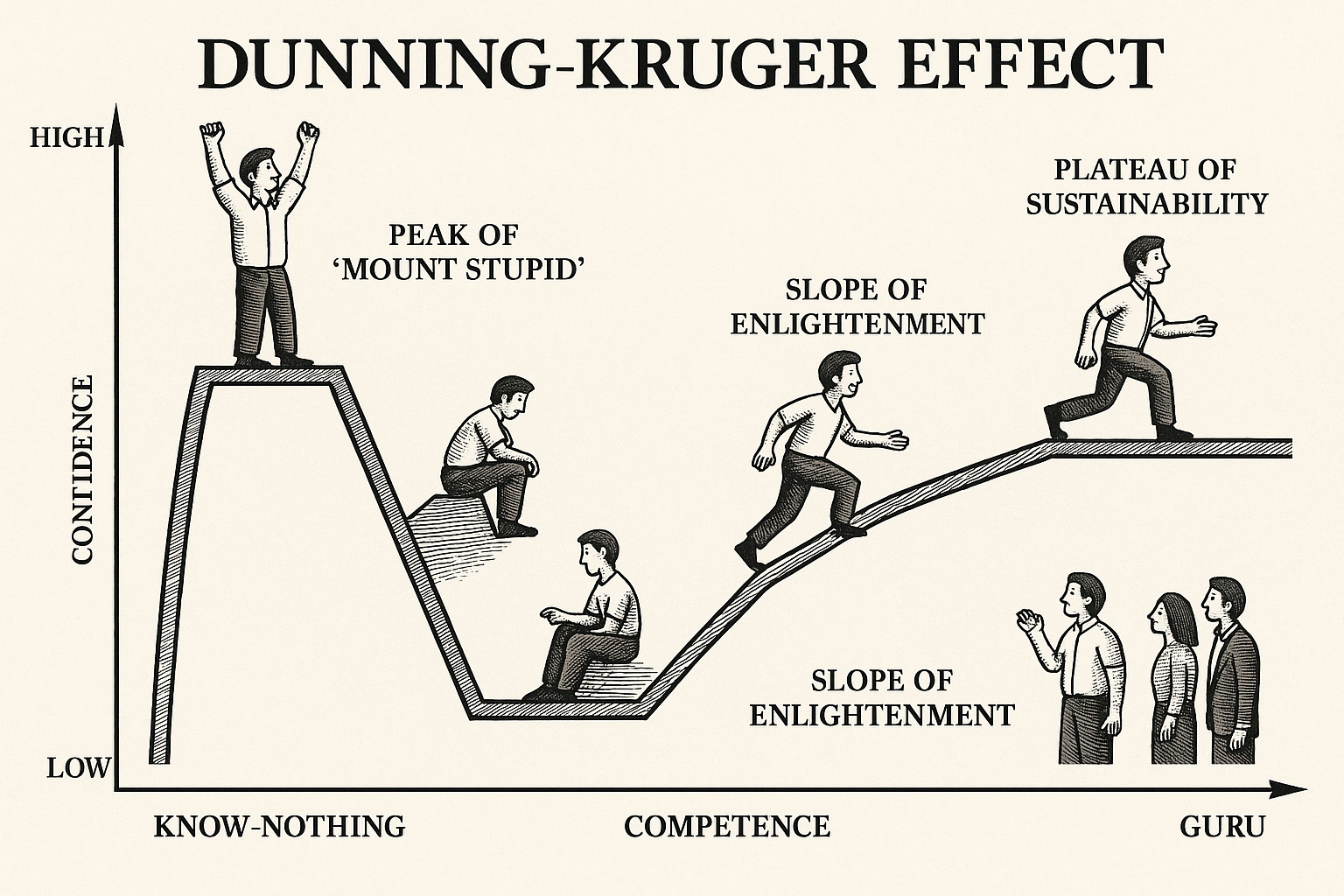
Those who are already knowledgeable, wise, and creative within their domain will use LLMs as a tool to amplify their expertise and extend their capabilities. The next generation of devs who build knowledge, earn wisdom, and hone creativity through time, repetition, and experience will be equipped to find their own innovative uses for LLMs in their workflow. We expect to fistbump these folks as we continue our lifelong ascent up the slow, steady Slope of Enlightenment.
Different Approaches to Developing LLM Models
The same is true for the folks building these models: How they build them, and what they build them to do, determines the quality of what the models are able to produce.
The AI giants have cared more about usage volume than use case fit. They were able to grow so quickly because they already had access to the gobsmacking amounts of data they needed to feed and grow their models. As the returns from scaling up data and compute have begun to diminish, we are slowly starting to see the potential for competition.
We are hopeful for a world where the biggest labs are not the only players, where smaller models to emerge as competitive alternatives: LLMs trained on clean, curated, domain-specific data, serving narrower use cases, delivering cheaper inference, and demanding less compute. We hope to see the possibility for more usage of proprietary, in-house LLMs: specialist AIs focused on narrow domains of knowledge to meet their business demands. And, it goes without saying, we hope to see the control of these tools decentralized and managed in ways that much more carefully approach issues of environmental justice and privacy.
Conclusion
Tools don’t just serve us. They change us.
Back in 1967, Father John Culkin, a Professor of Communication at Fordham University, wrote about how humans design technologies with intention, only for those technologies to unintentionally reshape human behavior, culture, and cognition. “We shape our tools,” he wrote. “And thereafter our tools shape us.”
As LLMs continue to transform the hour-to-hour, week-to-week work of software development, how will they transform us?
Devs are already spending significantly less time writing code and more time planning and reviewing it. What will happen to the skills of those senior devs who are tempted to offload more and more of their craft to a machine that is completely indifferent to its outputs? Who is to be held accountable for a decision made by a machine that “can never be held accountable”? Can LLMs develop the sort of decision-making prowess that comes from real expertise? Will machines someday derive satisfaction and meaning from building something to the best of their abilities?
Maybe someday. But today, those sound like desired solutions in search of actual problems.
Whew, that was a lot! What did you think of our series? Are you coming out the other side transformed from AI Doomer/Boomer to AI Pragmatist? Is there anything we didn't cover today that you find essential to maintaining a level head during this wild time in tech? There are two ways to keep exploring this topic with us:
First, you can always reach out on Twitter or through our contact form to ask questions, share insights, or let us know how you're using, thinking about, or planning to build with LLMs.
Second, you can check out our new podcast, "Pragmatic AI." In each episode, Tighten CEO Matt Stauffer explores how people across different fields—from business leaders to developers, from technologists to teachers—develop their relationship to AI and work to stay human while using it. If you're looking for honest, grounded conversations about AI from a range of perspectives, check out the trailer below or subscribe on your platform of choice to catch new episodes every Wednesday.
Thanks for reading, and stay human out there. Catch you next time! 👋
in your inbox:
let’s talk.
Thank you!
We appreciate your interest.
We will get right back to you.